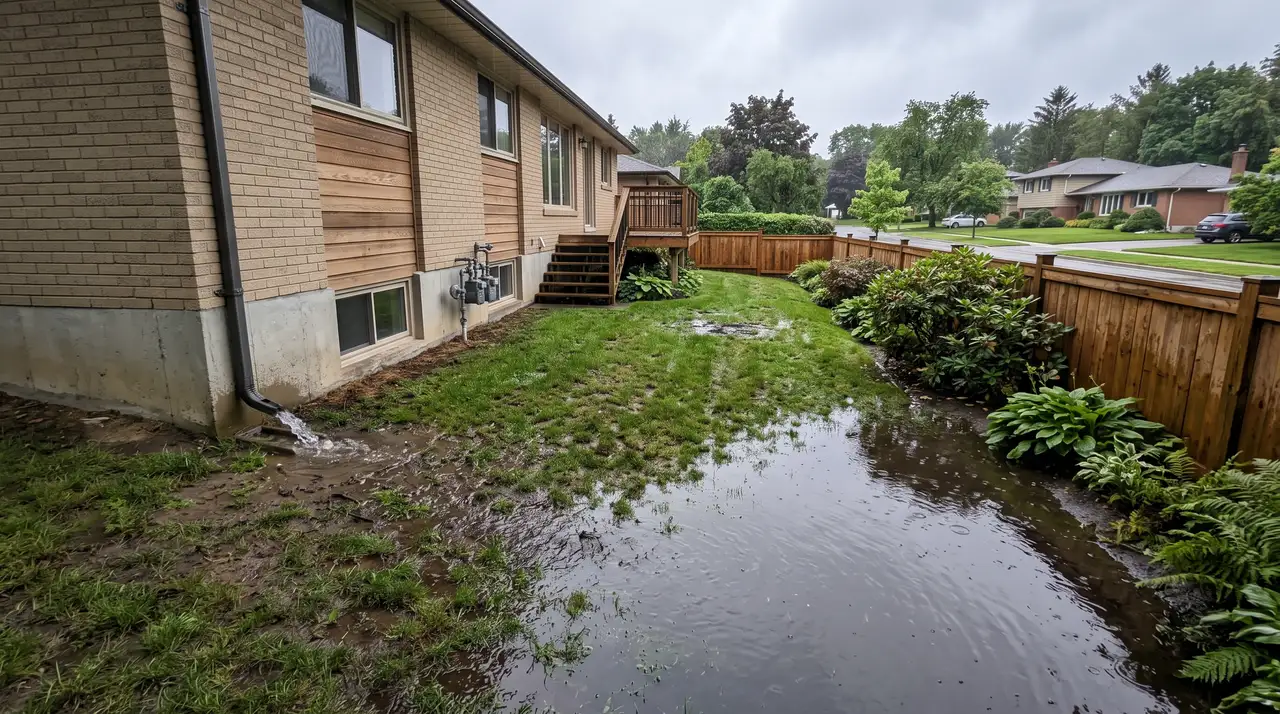
Per-foot pricing works for a straight run through open lawn and stops working for everything else. What moves the number is whether the ground takes water at all, and whether there is a legal, downhill place to send it. Both are properties of the site, not of the length.
How much of the ground here sheds rather than drains
The soil survey splits Layton close to down the middle: 46% of the mapped ground sheds water and 54% takes it in. A split like that is the awkward case for a per-foot rate, because two runs a few streets apart can be two different jobs. It also means the infiltration test is worth doing rather than assuming — on the draining half a dry well works and is cheap, and on the shedding half the same design is a hole that stays full.
The reasoning behind that
Yard drainage is priced per foot when the work is uniform: same depth, same soil, same surface, one outfall. Real yards are rarely uniform. A run that crosses a driveway, passes a mature tree, or changes depth to keep fall is three different rates in one length.
The bigger variable is the destination. Water has to arrive somewhere. On a sloping lot that somewhere is often free. On a flat lot it is a dry well sized to hold a storm, and the sizing is set by how fast the surrounding ground can absorb what is put into it.
A quote worth comparing states the depth, the pipe, the stone, the fabric and the outfall separately. Two per-foot numbers from two firms are not comparable unless those five match.
More on this: Yard and Lawn Drainage in Layton, UT.
Every question, in one place: Layton Utah French Drain drainage questions.
Check the Layton Utah French Drain service area to see whether your street is covered.
Back to Layton Utah French Drain.